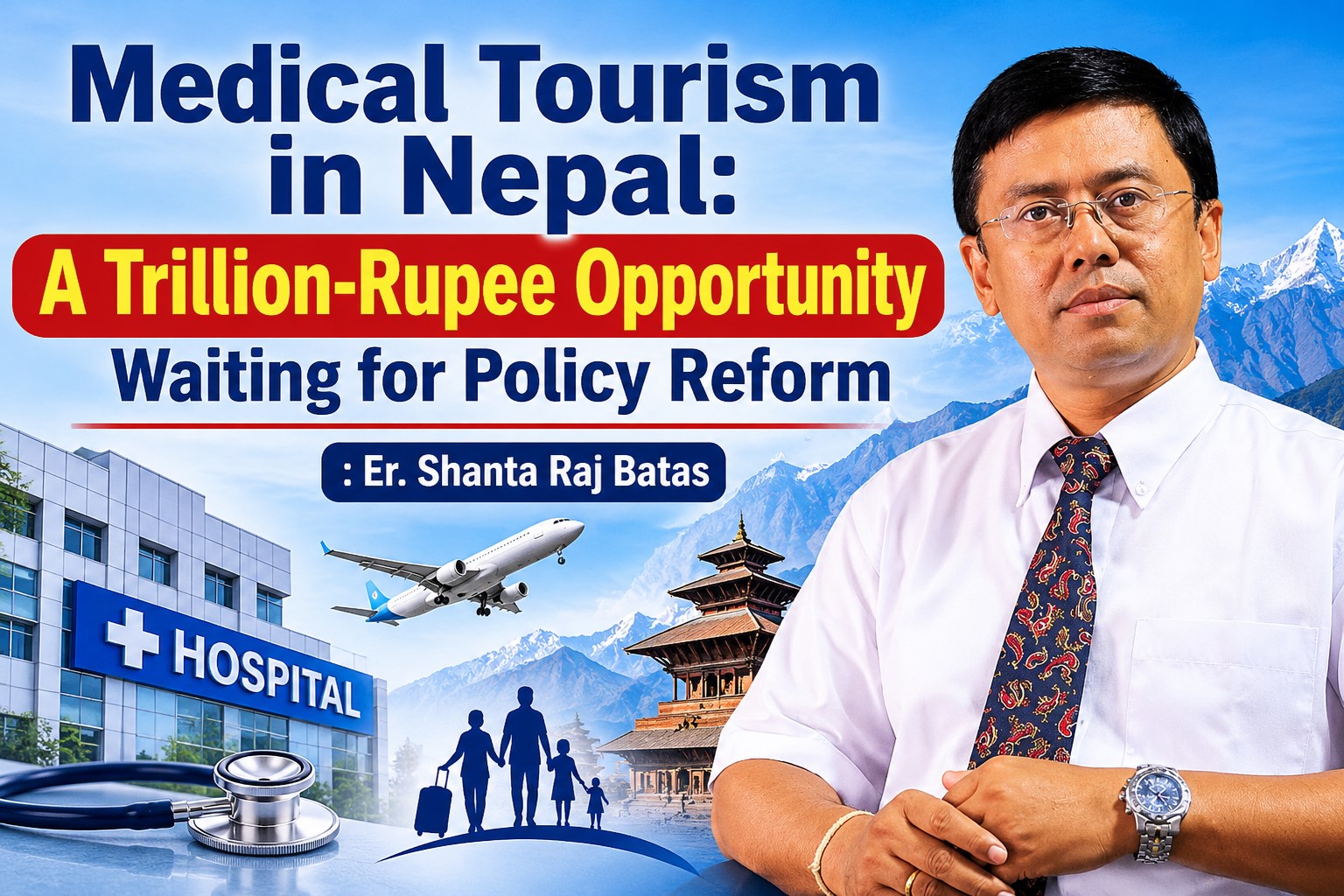
Medical Tourism in Nepal: A Trillion-Rupee Opportunity Waiting for Policy Reform: Er. Shanta Raj Batas
१५ कार्तिक, २०८३
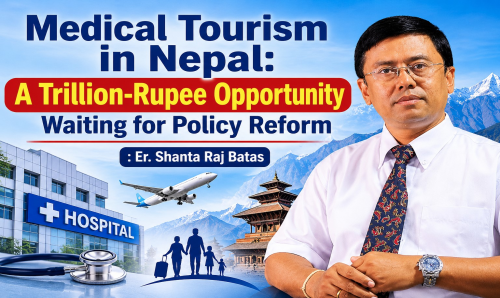
Nepal has a significant opportunity to become a regional hub for medical tourism and medical education. Learning from Cuba and India, Nepal can attract international patients and medical students through affordable healthcare, skilled professionals and existing infrastructure. However, policy reforms, investment and effective international promotion are essential to unlock this potential.
Learning from Cuba and India to position Nepal as a regional hub for medical education and healthcare services.
Cuba: A Model for Turning Healthcare into an Export Industry
Cuba offers an interesting example of how a relatively small country can transform healthcare services and medical education into major sources of foreign exchange earnings. Despite facing economic sanctions imposed by the United States, Cuba has developed an extensive healthcare system and established an international presence through medical services and professional healthcare exports.
According to the figures presented in this study, Cuba has a population of approximately 11 million, compared with Nepal's 30 million. Its geographical area is 109,884 square kilometres, while Nepal covers approximately 141,000 square kilometers, making Nepal about 28 Present larger. Cuba reportedly has 8.2 doctors per 1,000 people, among the highest doctor-to-population ratios in the world. The Cuban government operates 15 medical universities and approximately 150 fully equipped hospitals.
Cuba's healthcare sector has become an important source of international revenue. According to the supplied figures, medical exports generated approximately US$6.3 billion in 2018, while professional healthcare service exports averaged US$11.54 billion annually during 2011–2015. Approximately 50,000 Cuban doctors reportedly work in 62 countries. Venezuela is one example of a healthcare cooperation model involving the exchange of medical services for oil and financial resources.
Cuba has also developed medical tourism as an international service. The supplied figures indicate that medical tourism generates approximately US$40 million, with around 2,000 foreign patients reportedly visiting the country daily. A hip replacement procedure costs approximately US$8,000 in Cuba compared with US$63,000 in the United States. Cuban medical colleges reportedly produce approximately 20,000 healthcare professionals annually, including doctors and nurses. The government provides free medical education to its citizens and collects a levy from healthcare professionals working abroad.
Cuba's experience demonstrates that a relatively small country can develop healthcare services and medical education into internationally competitive sectors. If Cuba can build such a model despite economic challenges, Nepal should also explore opportunities to develop its healthcare sector as a major export industry.
India: A Successful Medical Tourism Model
India has emerged as one of the major destinations for international medical tourism. Affordable treatment, modern hospital infrastructure, skilled medical professionals and government support have helped the country attract patients from different parts of the world.
According to the figures presented, revenue from clinical treatment alone reached approximately US$8.7 billion in 2025. India aims to generate US$16.2 billion by 2030 under its Heal in India initiative. More than 500,000 foreign nationals reportedly visited India for medical treatment in 2025, with Bangladesh representing one of its largest source markets.
India's broader medical travel market, including hospital expenditure, transportation and accommodation, was estimated at US$23.84 billion in 2025 and is projected to reach US$26.96 billion in 2026 and US$72.11 billion by 2034. Treatment costs in India can be 60–90% lower than in the United States and Europe. For example, bypass surgery may cost approximately US$5,000 in India compared with US$100,000 in the United States.
The Indian government has actively promoted medical tourism through its Heal in India initiative, international marketing, e-Medical Visa facilities and proposals to establish five regional medical hubs in the 2026 Budget. Eligible medical visa applications reportedly receive processing within 72 hours. India's experience demonstrates that medical tourism requires more than hospitals and doctors. It needs coordinated government policies, international marketing, accessible visas, quality assurance and private-sector participation.
Nepal's Opportunity in Medical Tourism
Nepal has considerable potential to develop medical tourism by utilizing its geographical location, favorable climate, relatively affordable healthcare services and relationships with neighboring countries. Bangladesh, in particular, could become an important potential market for Nepal.
According to the estimates presented, approximately 300,000 Bangladeshi patients travel to India annually for medical treatment. Nepal could explore attracting a portion of these patients through affordable treatment, better connectivity and specialised healthcare services. Nepal has good air and land connectivity with Bangladesh, favorable climatic conditions and friendly diplomatic relations. The possibility of offering selected medical procedures at lower costs than India could provide an additional competitive advantage.
Changing circumstances in Bangladesh–India relations and difficulties in accessing Indian medical visas may create opportunities for alternative medical destinations. Private hospitals in Kunming, China, have reportedly been attracting Bangladeshi patients, particularly amid difficulties in obtaining Indian medical visas. Some hospitals have appointed medical agents in Bangladesh to promote their services and attract international patients.
Similarly, several Indian private hospitals have established contact offices and appointed agents in Nepal to attract Nepali patients to India. Nepal should adopt a similar international marketing strategy to attract foreign patients and promote its healthcare services in neighboring countries.
Nepal already has several potential areas for medical tourism, including organ transplantation, complex and critical surgeries, eye treatment, maternal and reproductive healthcare, and specialized medical services. Medical education can also become an important component of this strategy. Nepal could attract international medical students through MBBS and BDS programs, as well as short-term and long-term internship opportunities at medical colleges.
Before the establishment of the Medical Education Commission, Nepal attracted medical students from countries such as the United States, the United Kingdom, South Africa, Canada, Maldives and Sri Lanka. This historical experience indicates that Nepal has the potential to develop an international market for medical education. However, the country needs to promote its healthcare services, medical education programs and related products more effectively in the global market.
Policy Reforms: What Nepal Needs to Do
To establish Nepal as a regional medical tourism and medical education hub, the government must undertake comprehensive policy reforms. Existing policies, Acts, regulations and bylaws should be reviewed to facilitate healthcare services while maintaining appropriate standards of quality and patient safety.
One important area is organ transplantation. Eligible private hospitals and medical colleges should be allowed to provide transplantation services under established guidelines and clinical protocols. A single-window approval system could simplify the process, with decisions within two working days for complete applications where legally and clinically feasible. Currently, restrictions on doctors providing transplantation services at only one hospital can limit the utilization of specialized human resources. Qualified doctors and experts should be allowed to serve at other eligible hospitals, particularly because organ transplantation is a highly specialized field with limited expert availability.
According to the estimates presented, more than 75,000 people in Nepal require organ transplantation. The potential regional market is even larger when neighboring countries are considered. Bangladesh has a population of approximately 150 million, while India's Uttar Pradesh, Bihar and West Bengal together have more than 500 million people. This represents a significant potential market for Nepal's medical tourism industry.
Another important reform concerns the import of medical equipment. The government should consider reducing import duties on medical equipment to approximately 1 neighboring country. Rather than increasing the cost of essential medical equipment through high import duties, Nepal should focus on generating revenue through healthcare services. Lower equipment costs can reduce hospital investment and operational expenses, making treatment more affordable and competitive for international patients.
Nepal also needs to increase the production of specialized doctors and consultants. Greater investment should be directed towards organ transplantation, cardiac surgery, critical and complex surgeries, knee replacement, orthopedic procedures and other specialized medical services. Developing expertise in these areas would strengthen Nepal's ability to provide advanced treatment and attract foreign patients.
The establishment of government-owned super-specialty hospitals should also be considered in major cities and regions with international and domestic air connectivity. Such hospitals could become centers for advanced treatment, international patient services and medical education. The government should also encourage international marketing, appoint regional representatives and establish contact offices to attract foreign patients and international medical students.
Nepal should review its legal framework concerning surrogacy and assisted reproductive services. The possibility of allowing appropriately regulated private hospitals to provide such services should be considered in accordance with national law. Many couples in developed countries seek assisted reproductive services and may consider international destinations for treatment. However, any such policy must strictly protect the rights, health, dignity and safety of surrogate mothers and children.
The government should also consider allowing the import of eligible refurbished medical equipment, subject to appropriate safety, quality and certification standards. The United States, United Kingdom and Japan are major markets for used and refurbished medical equipment. If refurbished aircraft can operate in Nepal under applicable aviation safety standards, appropriately certified refurbished medical equipment should also be considered under suitable regulatory standards. Such a policy could reduce the capital investment required to establish and upgrade hospitals.
Medical Education: An Opportunity to Build a Regional Education Hub
Alongside medical tourism, Nepal should develop medical education as a major international service export. According to the estimates presented, Nepal's existing public and private medical college infrastructure could potentially accommodate approximately 10,000 MBBS students. However, the country needs to create a more competitive policy environment to attract international students.
Several Caribbean countries, Russia, Ukraine, Kyrgyzstan and Uzbekistan have developed large-scale medical education institutions. Some medical schools in these countries reportedly operate from multistorey buildings covering approximately 100,000 square feet and produce 500–1,000 doctors annually per institution. A significant proportion of their graduates reportedly pursue further qualifications and professional opportunities in countries such as the United States, United Kingdom and Australia.
In Nepal, however, the existing regulatory framework limits the annual intake of many medical colleges to approximately 100–150 students, despite some institutions having infrastructure capable of accommodating 300–500 students annually. This raises questions about whether existing policies are restricting the effective utilization of available infrastructure and investment.
Under Nepal's current requirements, establishing a medical college with 100 MBBS seats may require at least 100 Rupanis of land in hilly regions or 10 bighas in the Terai, approximately 300,000 square feet of building space and a 300–500-bed teaching hospital. The estimated investment is approximately NPR 5 billion.
According to the comparative estimates presented, the cost of owning and operating medical colleges in Caribbean countries is approximately one-third of that in Nepal. This difference is also reflected in medical education fees. Nepal therefore needs to review its medical education regulations and identify ways to reduce unnecessary infrastructure and operational costs without compromising educational quality.
This is the age of digital technology. Simulation laboratories and skills laboratories are now widely used to provide practical training in different professional fields. Flight simulators, for example, have transformed pilot training by allowing trainees to develop essential skills in a controlled environment. Similar technologies can be used in medical education to improve practical learning, clinical skills and training capacity. Nepal should adopt modern teaching technologies and internationally recognized educational practices to make medical education more affordable and competitive.
Conclusion: Policy Reform Is the Key
Nepal has a significant opportunity to develop itself as a regional destination for medical education and medical tourism. The biggest challenge is policy reform. Policy reform should be the national priority.
The government needs to review existing policies, Acts and regulations with an open mind, considering changing international market dynamics, regional opportunities and the potential economic benefits of healthcare services. Bold but responsible decisions are necessary in the national interest.
Medical education and medical tourism are not merely commercial activities. They can become important contributors to employment, professional development, foreign exchange earnings and national economic growth. According to the estimates presented, Nepal's existing medical education infrastructure could potentially accommodate at least 5,000 foreign medical students, with a longer-term target of 10,000 students from international markets. Nepal already has potential markets within the SAARC region and neighbouring countries, including Myanmar.
Overall, medical education and medical tourism could potentially contribute approximately NPR 10,000 crore (NPR 100 billion) annually to Nepal's economy. If Nepal reaches a Government-to-Government (G2G) agreement with India for mutual recognition of medical degrees, this potential could reportedly increase to NPR 2 trillion annually.
For comparison, Nepal earns approximately NPR 30 billion annually from electricity exports and NPR 75 billion from tourism, according to the figures presented. Medical education and medical tourism could become another major contributor to the national economy if the country develops the necessary infrastructure, policies and international partnerships.
The government should also consider including this agenda in the upcoming visit of Prime Minister Balen to India, particularly through bilateral discussions on mutual recognition of medical degrees and cooperation in healthcare services.
With appropriate policy reforms, effective international marketing, quality healthcare services and coordinated efforts between the government and private sector, Nepal can work towards becoming a regional hub for medical education and medical tourism.
Nepal has the infrastructure, geographical advantage, regional market and human resources to pursue this opportunity. What it needs now is bold, practical and nationally focused policy decisions.
(Er. Batas is the Treasurer of the Association of Private Medical and Dental Colleges of Nepal)








प्रतिकृया दिनुहोस